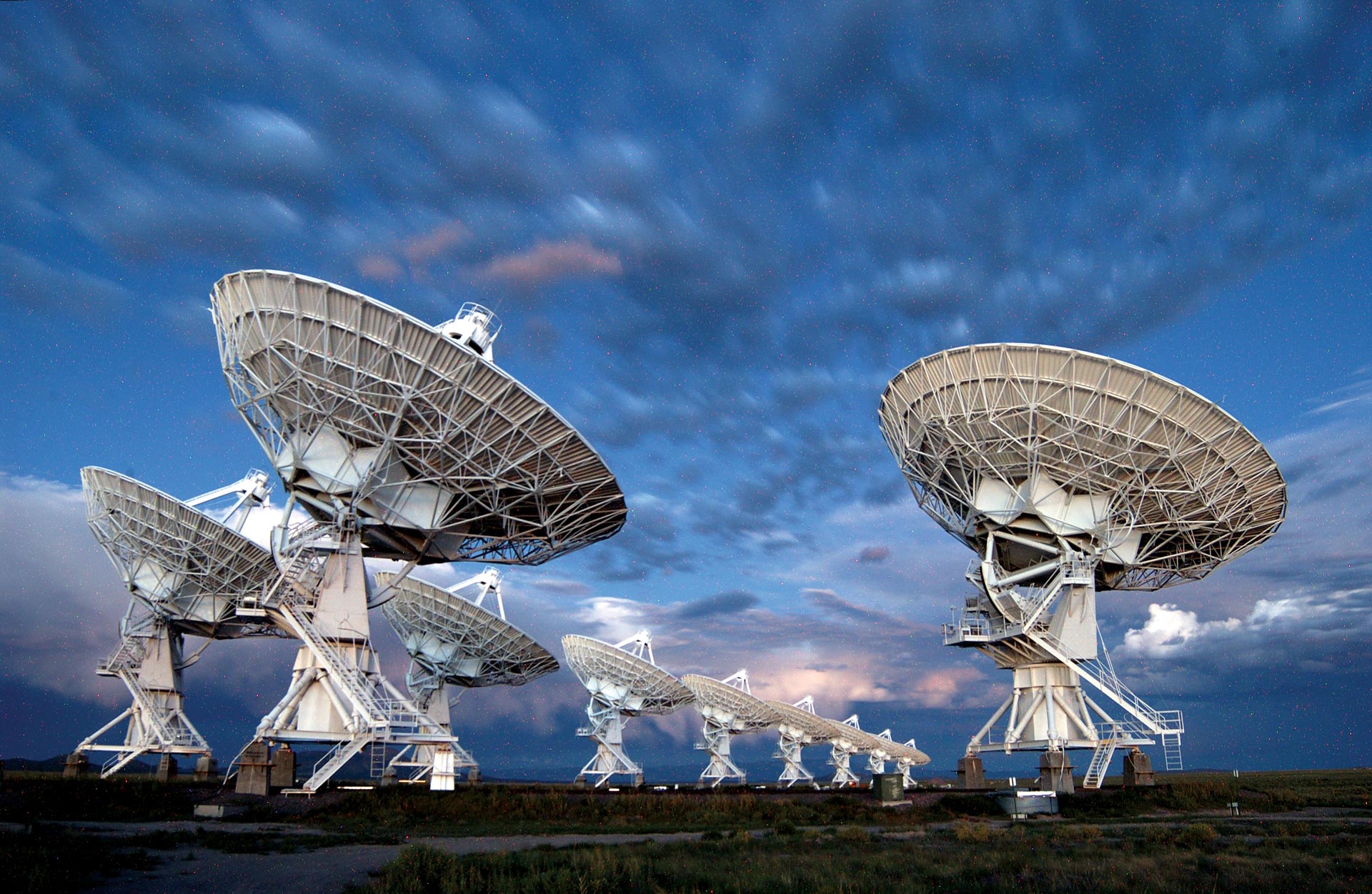
New Mexico’s Very Large Array (VLA) at twilight
Opinion
In spite of government theatrics, the answer to an age-old question remains the same
This article was first published in Substack
I’m a scientist, an astrophysicist and an educator by training. I was educated in a bygone era when you actually had to think, pay attention to detail, use your intelligence -your actual intelligence, read, study, develop critical thinking skills and observe the world around you – all on your own! We didn’t have a device in our pockets that would tell us the time of day, what to do or give us the answers to any and all questions we had as we went about our daily lives. We figured things out on our own – without the Internet or some device in our pockets. An age-old idiom comes to mind: “if you don’t use it, you’ll lose it” and that’s exactly what’s happened. If you don’t use your mind, you’ll lose it.
It was bad enough with smart phones. Up until only a year or so ago, everyone relied on their phones to navigate, to balance their checkbooks and to answer any question that would arise in a given conversation. Now it’s a 100x worse with AI – and AI will either go bust or will be the end of us.
Decades ago, we didn’t have smart phones or Google Maps – we looked at a map, used our spacial intelligence and followed the road if we had to get from point A to point B. There were no smart devices when I was in high school. We solved physics problems using a slide rule! How many reading this know what a slide rule is, how to use one or has ever seen one? These basic skills are now gone – almost entirely.
Many from my generation are either retired, deceased or have given up. Some of us are still here however, but we’re not being replaced or are we coming back. We did our jobs, we taught the next generation (the Millennials) and now, it’s their turn. This is quite worrisome when you consider that the new generation following them (young Gen-z or now shriek(!), Gen-Alpha) can’t read a clock or tie their own shoes without some device telling them how or what to do – this isn’t hyperbole, they really can’t! We’re graduating high school seniors now who literally can’t read a clock and don’t know how to tie their shoes!
So what does any of this have to do with the title of this piece?
Lacking any critical thinking skills, now made 100x worse with AI and the torrent of slop and misinformation being substituted for actual news, many today will become victims of science fiction, misinformation and nonsense being peddled as truth.
The powers that be have a very definite reason why they’re normalizing the idea of extra-terrestrials, sentient beings not indigenous to this planet, here, now living among us – and that it’s time for Disclosure Day!
Indeed, the US House Oversight Committee held hearings between 2023 – 2025 during which time US Navy fighter pilots gave testimony, describing their alleged encounters with UAP’s (Unidentified Anomalous Phenomena). By the way, what was wrong with “UFOs” that we now need a new moniker? Same meaning, right but without Roswell and all the other Hollywood myths attached? Who knows?
We all watched the videos – I did. There was nothing there – nothing but a hotspot, or other digital artifact of the camera or recording equipment. There was no “UAP” flanking the F-18 at supersonic speed. It was then and remains today, a big nothing burger.
Without another Bogeyman to worry about, there’s no reason for “The Space Force” or a trillion-dollar+ NDAA budget every year. The sales pitch [to Congress] will now be: The Aliens are coming!
And this is where the story begins.
Frank Drake and his Equation
In 1961, Cornell astronomer Frank Drake devised a formula that, if you input the correct values, out would emerge the estimated number of technically advanced civilizations that exist in the galaxy at any given time. Clearly, the values would have to be determined with the best scientific methods available at any given time. Since first published, the equation has been widely used.
At the time, Frank’s equation was intended to serve as the agenda for the first meeting on the topic of SETI (Search for Extra Terrestrial Intelligence). In 1960, he had conducted a pioneering search for extraterrestrial signals – a several-week long effort he named Project Ozma. Somewhat unexpectedly, his equation and this modest experiment attracted a great deal of attention, and Drake was encouraged by officials at the National Academy of Science to organize an informal gathering of accomplished researchers and engineers to discuss the prospects for finding a signal.

R∗ = the average rate of star formation in our galaxy.
fp = the fraction of those stars that have planets.
ne = the average number of planets that can potentially support life per star that has planets.
fl = the fraction of planets that could support life that actually develop life at some point.
fi = the fraction of planets with life that go on to develop intelligent life (civilizations).
fc = the fraction of civilizations that develop a technology that releases detectable signs of their existence into space.
L = the length of time for which such civilizations release detectable signals into space. Or, other variations include: “mature and develop into a planetary or star-faring civilization”. Albert Einstein famously said that “I do not know with what weapons World War III will be fought, but World War IV will be fought with sticks and stones.”
All but one term, the last one (L), can be estimated reasonably well. Why?
We’re at the point now, with the current geopolitical situation, where we would have a firm number for L of ~90 years or, if cooler heads prevail, we could keep going. What is our first reference point, the point where we start the clock for L? It would be when we first broadcast evidence of our presence in the galaxy. That occurred quite inadvertently with Hitler’s opening speech at the 1936 Olympic Games, held at Berlin’s Olympiastadion. This coming Saturday, August 1st, will mark the 90th anniversary of the 1936 games, therefore, as of now, L is accurately determined to be 90 years.
Estimates for N range between 1 and 100. Even though the galaxy is huge (~100,000 light years in diameter), the odds of any given star out of the ~200 billion stars in the galaxy being host to at least one planet that could sustain life is quite small.
For argument’s sake, let’s assume N = 10. This means that there are 10 civilizations in the galaxy at this moment in time with the technical means of interacting with us, either from a long-distance (Drake’s Project Ozma and SETI) or, up close and personal (Independence Day, the 1996 version, Close Encounters of the Third Kind with Richard Dreyfuss, etc…etc). The “up close and personal” version is what they want to normalize.
To provide a sense of scale and just how huge the galaxy is, our position in the outer 1/3 of the galaxy takes 225 million years to complete one orbit. Since the emergence of the dinosaurs 252 million years ago, our sun has barley completed one orbit around the galaxy.
Adopting a value of 10 for N, the number civilizations that would be capable of making contact with us, either by long-distance or up close and personal, we divide the galaxy into 10 equal regions whose volume is described by a disk with a radius of 13,000 light years. For the purposes of this calculation, we’ve omitted the approximate radius of the galactic bulge ~10,000 light years. It’s simply too dense and an environment most likely hostile to any sustained development of life.
If we distribute the 10 advanced civilizations equally throughout the galaxy, each of them would occupy a region of space in our galaxy 26,000 light years in diameter. Traveling at the Speed of Light, it would take 26,000 years to traverse only one of them. Given that we’re one of the 10, our sun and solar system would be in one of these regions.
Take, for instance, the example where a civilization’s system is at the center of one such region and another at the border of an adjacent disk. A brief, long-distance conversation consisting of “Hello, we’re here; do you copy?” and the reply, “Hello, yes, we copy; we’re here” would take 26,000 years (13,000 years for the initial message and another 13,000 years for the reply).
As for the “Up close and personal” contact, the one that they want to normalize, we landed a man on the moon 6 times out of 7 attempts between 1969 and 1972 and now, with Artemis II, we finally went back to lunar orbit and returned home. We’ve been unable to achieve now what we achieved over 50 years ago and the moon is only 384,000 kilometers distant. And terraforming Mars or establishing a Martian outpost is a pipe dream Elon Musk keeps having – it ain’t happening anytime soon. Who will be the engineers who build the ships and transport vehicles necessary to establish even a lunar outpost, the Gen-Alpha high school graduates who can’t even read a clock or tie their shoes?
Getting back to the “Up close and personal” contact, the kind of fantasy depicted in Steven Spielberg’s Disclosure Day, would require Interstellar travel. Accelerating to even 10% light speed would require enormous amounts of energy, the kind of energy we’re centuries away from developing, if ever. We’re just at the cusp of sustaining a controlled nuclear fusion reaction, you know, the kind that powers the sun and all stars. Nuclear fission is a mature technology that has been around since the close of WWII and the early 1950s.
Special Relativity
At 10% light speed, it would take 43 years to reach the Alpha Centauri star system, our closest stellar neighbors. And the energy requirements increase exponentially the faster you accelerate. As you exceed 50% light speed, the effects of Special Relativity begin to manifest. What happens? Your mass increases, time slows down and your length in the direction of travel shrinks. At 50% light speed, your mass has increased by 15%.
As you continue to accelerate, the energy requirements increase exponentially to compensate for the increased mass. If we establish 50% light speed as a top speed, it would take 11 years to reach Alpha Centauri – if we were able to accelerate to that speed immediately. In reality, at least half of the journey would be spent accelerating -and then slowing down -for the same amount of time. What would have taken 11 years would take 17 years as experienced by the crew and 18 years relative to earth. This is a one-way trip too, so forget about coming back home. Why? Time dilation, fuel and supplies. Everyone you knew, that you left behind to go on this journey, is a year older relative to you. Time slows down for you, not for them. Time has slowed down for you while they’ve aged at the normal rate. These effects are minimal because of the speed cap and the relative proximity of the destination. For greater speeds and more extended journeys into the galaxy, the time dilation effects of Special Relativity would be brutal.
Another bleak reality: as your journey progresses, communicating with earth takes longer and longer. Radio communications occur at the speed of light. At the half-way point or 2.15 light years out, any two-way conversation would take 4.3 years to complete! Another detail: they wouldn’t know on earth if or when you’ve arrived for 4.3 years (the distance to Alpha Centauri is 4.3 light years).
At 90% light speed, your mass has doubled, at 99% light speed, your mass has increased 7x and time has slowed down by the same amount! The speed of light is the universal speed limit. Nothing with any mass can travel at the speed of light, nothing.
Mass increase, time dilation and length contraction occur at the same time and at the same rate.
Hyperdrive or Warpdrive
Then there is the matter of an advanced Hyperdrive or Warpdrive. These means of propulsion don’t actually move your starship at light speed or greater but emulate that speed by “warping”, “curving” or, in fact, “shortening” the space in the direction of travel, emulating superluminal (faster than light) travel. These ideas do have a remote basis in Einstein’s General Relativity but remain relegated to the realm of science fiction and probably always will be.
So, are we thus destined to remain alone in the galaxy, in the universe, perhaps become an interplanetary civilization or maybe, within 500 years, establish an outpost in the Alpha Centauri system? Maybe, if we don’t blow ourselves up beforehand. And that brings me to Fermi’s Paradox.
Enrico Fermi and His Paradox
In the summer of 1950, the great Italian-American physicist Enrico Fermi wondered out loud, “where is everybody?” As the story goes, he posed this question regarding the existence of, or more specifically, the lack of any evidence for, extra terrestrial visitors while having lunch with fellow physicists Edward Teller, Herbert York, and Emil Konopinski. The men were discussing recent UFO reports and the possibility of faster-than-light travel. The conversation moved on to other topics, until Fermi blurted out, “But where is everybody?”
Given that the galaxy is teeming with 100s of billions of stars, many with planetary systems with some small percentage perhaps capable of supporting life, it is reasonable to ask where is the evidence of ET’s existence or that they were here.
My article here takes an in-depth dive into Fermi’s original question. The sobering reality is that if we don’t stop our endless wars, we will have answered Fermi’s question with our own reality and the answer will be: When we start launching nuclear weapons at each other, we will have committed suicide and Enrico Fermi’s question will have been answered.
And the answer will be: no civilization matures to the point where they don’t self-destruct and become a star-faring civilization.
We may be confronted with the sobering reality that we are really alone in the universe, or civilizations like ours ultimately self-destruct. Just look at the headlines now(!) and at all the wars fought throughout our short history, fought with what amounts to sticks and stones.
When we start launching nuclear weapons at each other, we will have committed suicide and Enrico Fermi’s paradox will have been answered.
Let me be clear: ET has never been here, not 3,000 years ago, not at Roswell and not now. To believe that they would have any interest in visiting us is the height of hubris. If they mastered the technical challenge of Interstellar travel, they would have no need for any “dialog”, or have any interest in a conversation except, maybe, if they needed natural resources. The whole world would know they’ve arrived and, lacking any particular interest in us, our politics or speaking with our “leaders”, they would take what they need and we would be powerless to stop them. Anything else is a fanciful, Hollywood myth designed to control the masses, cooked up to scare them into believing that we’re actually in control when we’re not.
Most likely, any of our subjective notions of morality or ethics would be foreign to ET. Just look at all our wars and colonial conquests over the past 1,000 years alone. The marauders came, they stole and they conquered without a second thought as to the lives and destiny of their vanquished hosts. Who ever tells their story? Who ever tells of their suffering and death? No one – history and the stories of glory and conquest are always told by the victor. This would most likely be the outcome of any extraterrestrial encounter. In fact, the late Stephen Hawking warned us of being too vocal, that we should reduce our outward-facing electromagnetic footprint: tone down the chatter and stop reaching out to ET!
There are no aliens here now, not now, not ever. When or if they ever show up – everyone will know and the government will be powerless to stop them or hide their presence.
So no, no 22-year old kid flying an F-18 was flanked by a UAP. Sorry, go sell that BS to Spielberg, not to anyone else who can actually think, read a clock or tie their shoes.
Astronomy for Change is an AI Free Zone

From Las Cumbres Observatory, a quick, interactive web-based view of the sky at the moment, complete with interactive controls The Sky Now. The page includes “The Sky Tonight”, a quick, interactive web-based version of Stellarium.
Astronomy For Change: https://astronomyforchange.org
Did you enjoy this article or like what we do? Why not leave a tip or buy us a Coffee?
Follow Us On Twitter: https://twitter.com/astronomychange
Why not support us on Patreon: https://www.patreon.com/astronomyforchange
Imagination is more important than knowledge

An index of all articles can be found here.
Comment Moderation Policy
If you enjoyed this article, please consider supporting us with a modest donation
or through a subscription on our Patreon Page
Membership at Astronomy for Change is Free!