
What Would the Sky Look Like from an Alien World at the Edge of 47 Tucanae?
Since the cluster is at the same distance as it is wide, it would completely dominate the sky at an angle of 90 degrees or 180x the size of the full moon! Picture the size equal to 180 full moons edge-to-edge and you can imagine the size of the cluster at this distance of 120 light years with its multi-million-star population. The combined light of these several million stars would cast a perpetual shadow, a permanent twilight. After Omega Centauri, 47 Tuc is the 2nd brightest globular cluster as seen from earth.
if you were on that planet, you wouldn’t see a “night sky” at all in the way we know it. The cluster’s combined light would be so diffuse and all-encompassing that the only dark patches would be the shadows cast by large terrain features (mountains, cliffs). And if the planet had a moon, it would be utterly invisible against that glowing backdrop—like trying to spot a candle in front of a searchlight.
Standing on that imaginary planet, with a globular cluster blazing across a quarter of the sky, you wouldn’t just be seeing the universe; you’d be inside it, immersed in a stellar metropolis where every direction you turn leads to light.
Fossilized Starlight
And here’s the real kicker: you’d be looking at 2 million stars that all formed at nearly the same time, over 13 billion years ago! That glow isn’t just light—it’s fossilized starlight, produced by ancient relics from the early universe, shining down on a world that may have never known a truly dark night.
To answer this question fully and to tell the story of this cluster and all globular clusters, it’s necessary to return to our own stellar neighborhood and look at the beautiful, ruby-red Arcturus, warm and inviting in our own sky. This red giant star is well known to anyone who has ever looked at the night sky.
Arcturus is a mere 37 light years distant which means that when we look up and see that star, we’re looking back in time 37 years at light that’s 37 years old, not as the star is today but as it was 37 years ago. For those millennials who are turning 37 any time soon, treat yourself to a free birthday gift. Provided its clear, go outside on your birthday evening (after the festivities, of course), find Arcturus and consider that the light you see that night left that star on the day you were born.
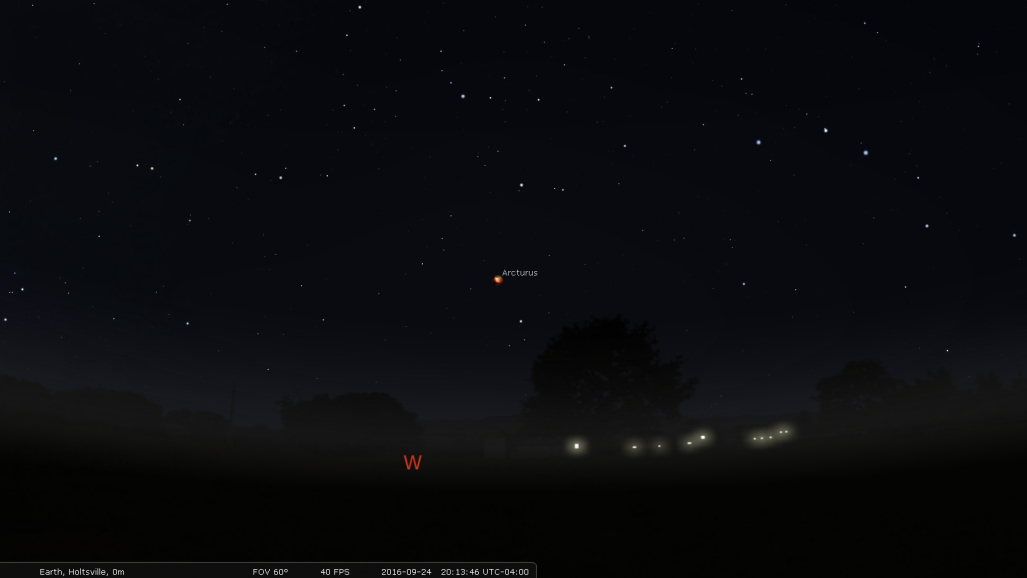
Arcturus
Arcturus is an evolved, red-giant star, a star very much like what our sun will be with an age of 7.1 billion years, 2.5 billion years hence. By contrast our star has an age of 4.6 billion years, a star separated in time from Arcturus by only 2.5 billion years. It has the equivalent mass of the sun but 170 times its luminosity, a result of its expansion to 25 solar radii, a natural consequence of the transition to helium burning in its core, a process that is producing carbon and oxygen, the raw materials for new life and new worlds.
Arcturus is one of the five brightest stars in the sky and the principal star in Bootes the Herdsman (click the thumbnail above to get a sense of where it is in the sky). It beckons red-orange, bright and friendly in our sky because it is a mere 37 light years distant; it is these stars, the evolved, red-giant stars that substantially populate globular clusters, objects such as 47 Tucanae, that allows us to see them at such staggering distances. Astronomically speaking, Arcturus is close in time and in space, it is also close to us in a profoundly deeper sense; as we look it, we are looking at a reflection of ourselves, our destiny, our own sun in a mere 2.5 billion years. This should give us pause to reflect on our humanity and future together, one race on this tiny, pale blue dot.
Look again at the feature image above. Do you see those red-orange orbs scattered throughout the cluster? Those are stars similar to Arcturus, a star warm and inviting in our own sky, only 37 light years distant. You see, all the stars of any globular cluster, millions of them in many cases, have uniquely evolved together over the eons of time since they and the cluster formed!
Globular clusters are stellar relics, dating back to an earlier cosmological epoch and thus, are unique stellar laboratories: to test our astrophysical models, to observe the behavior of stars in a unique setting, physically separated often by light days, not light years. In the case of 47 Tucanae and all globular clusters, these same stars, red giants such as Arcturus are the brightest, most luminous members of the cluster, not because they’re relatively hot but because of their enormous size, a size comparable to Arcturus at 25 solar-radii!
The Story is in the Color Magnitude Diagram
Take a look now at the following Hertzsprung–Russell Color Magnitude Diagram of 47 Tucanae. Arcturus would be midway up the red-giant branch arc at magnitude 12.3 while the diminutive sun would be below the the magnitude 17 Main Sequence “turnoff” point at magnitude 18.
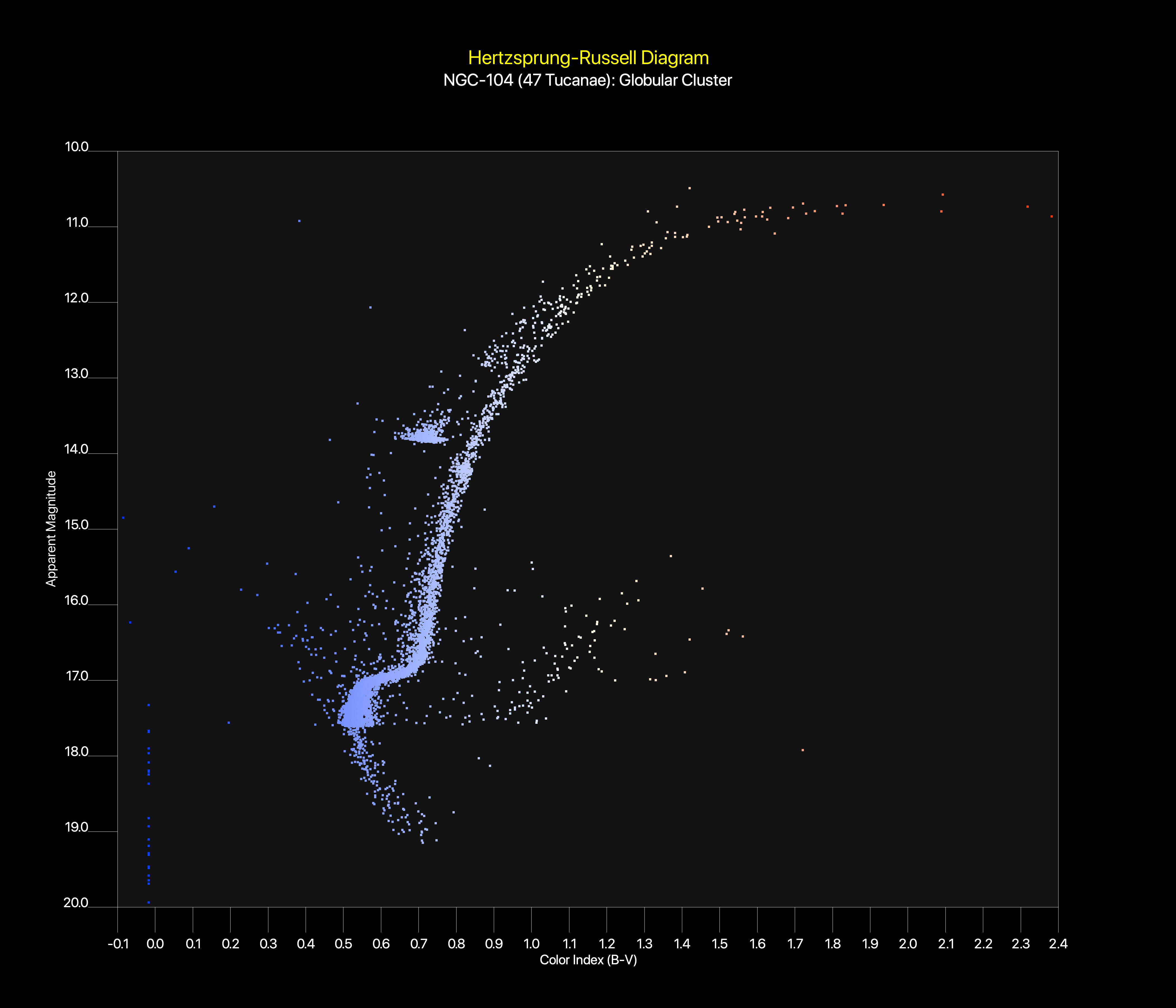
Color Magnitude diagram of 47 Tucanae produced by Astronomy for Change using PixInsight’s HR Diagram Plotting tool (contact the author for more info about this tool). The Main Sequence “turnoff” point at magnitude 18 is where the sun would be on this diagram. Arcturus would be midway up the red-giant branch arc at magnitude 12.3. Image credit: J. Daly, Astronomy for Change via PixInsight HR D Plotter
One of the features of our modified HR Plotting tool for PixInsight is the ability to identify a selected star either from the original source image or from the HR Diagram. We have done that here for a star in the same magnitude and luminosity class as Arcturus. The sun would be a diminutive speck lost among the myriad other diminutive specks seen in the image.
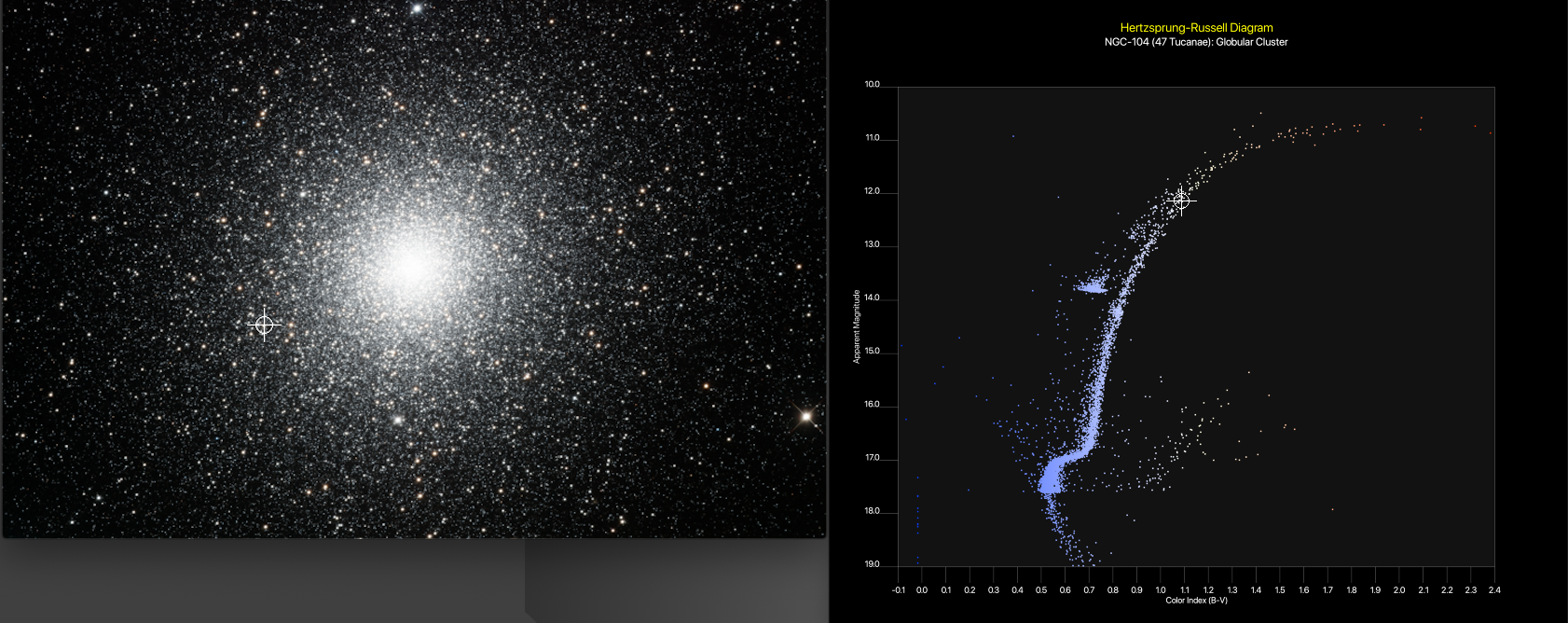
As described in the text, this star cluster and all globular star clusters have a significant population of evolved, red-giant stars. This is a comparative illustration, showing where a star such as Arcturus would be on the Color Magnitude diagram of 47 Tucanae and its location in the cluster. Note its appearance (color and brightness).
47 Tucanae
We are pleased to present this beautiful summer jewel of the Southern Sky. Even if you live in the northern hemisphere, you can still enjoy the breathtaking beauty of NGC-104 or 47 Tucanae as it’s also known. This colloquial name for the cluster is Latin for the southern constellation Tucana, the toucan, a bird indigenous to Latin America. The image data has been made available by our partners in Astronomy Education, Insight Observatory and their Starbase Portal. This image was produced by Astronomy for Change from the image data set now available on Insight’s Starbase portal. For the price of 2 Starbuck’s coffees, you can download and produce your own spectacular images of this and many other celestial favorites!
To enhance your experience, Stellarium will show you where this southern jewel box is located and help you locate Arcturus on your birthday!
If you enjoyed this article or it gave you pause to reflect, why not help us out with a modest donation, support our mission to affect positive change through astronomy and science education

Astronomy for Change is an AI Free Zone
From Las Cumbres Observatory, a quick, interactive web-based view of the sky at the moment, complete with interactive controls The Sky Now. The page includes “The Sky Tonight”, a quick, interactive web-based version of Stellarium.
Astronomy For Change: https://astronomyforchange.org
Did you enjoy this article or like what we do? Why not leave a tip or buy us a Coffee?
Follow Us On Twitter: https://twitter.com/astronomychange
Why not support us on Patreon: https://www.patreon.com/astronomyforchange
Imagination is more important than knowledge

An index of all articles can be found here.
Comment Moderation Policy
If you enjoyed this article, please consider supporting us with a modest donation
or through a subscription on our Patreon Page
Membership at Astronomy for Change is Free!