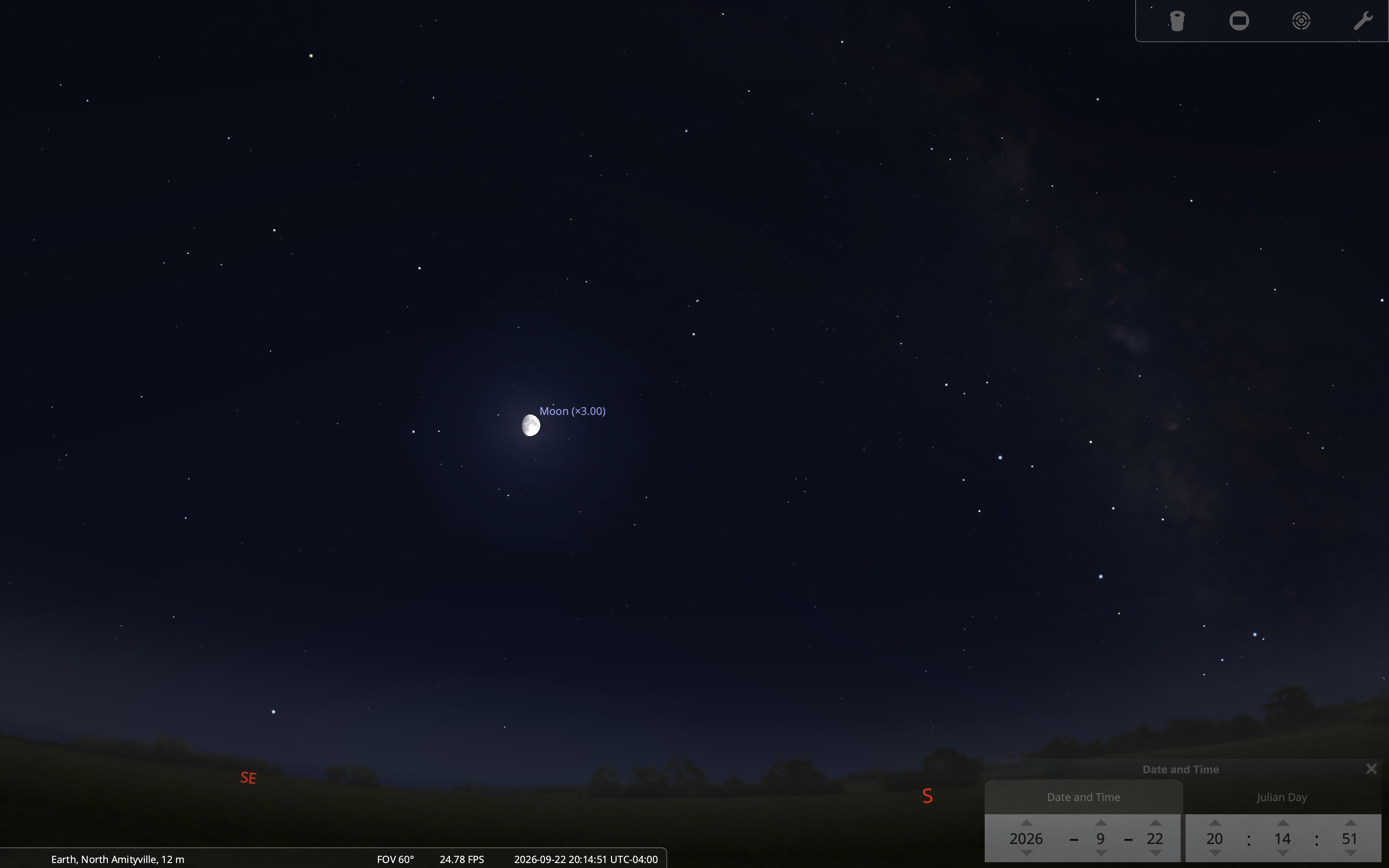
A view to the south-southeast on the night of this year’s Autumnal Equinox. The waxing gibbous moon is high in the southeast in Capricorn with the teapot of Sagittarius just west of the meridian and Scorpio, the scorpion, further west.
The Autumnal Equinox
The Vernal and Autumnal Equinoxes are two days during the year with 12 equal hours of daylight and darkness. The Vernal Equinox heralds the beginning of Spring and the Autumnal Equinox, Autumn.
The Autumnal Equinox for this year occurs Wednesday, September 23, 2026 at 00:05 UTC (Tuesday, September 22, 2026, at 8:05 PM EDT). Many astronomical dates throughout the year can be found here.
What does the ‘Beginning of Spring’ or the ‘Beginning of Fall’ actually mean, and what’s so special about these dates?
The changes we normally associate with the start of a new season are climactic, such as changes in temperature or weather. So, what does the ‘Beginning of Spring’ or ‘Beginning of Autumn’ actually mean? To answer that, we’ll have to consider the astronomical year in its totality and the other two significant dates during the year, the Summer and Winter solstices. Those events represent the points during the year when the sun is at its highest and lowest points on the sky respectively.
The sun, at its highest point during the third week in June (June 20-22) in the Northern Hemisphere, represents the ‘beginning of summer’. Likewise, the sun is at its lowest point during the third week in December (December 20-22) in the Northern Hemisphere, represents the ‘beginning of winter’. The two Equinoxes occur when the sun crosses the Celestial Equator at the midpoint between these highest and lowest points (see the view above). The Celestial Equator represents the projection of the Earth’s equator on the sky.
It should be noted that the Southern Hemisphere experiences the same seasons but at opposite times during the year. Summer in Australia occurs during December and January, while Winter occurs during June and July.
The Astronomical Beginning of Spring or Autumn are conventions, marking the first and second point respectively since the beginning of the year when the sun crosses the Celestial Equator.
The Vernal Equinox in March marks the first time there are 12 equal hours of daylight and darkness. Similarly, the Autumnal Equinox, occurring during the third week of September, marks the 2nd and final time during the year when there are equal hours of daylight and darkness.
What Happens During the Equinoxes?
12 equal hours of daylight and darkness.
The opposite seasons begin for our friends in the Southern Hemisphere.
The sun rises due east and sets due west at any point on the planet.
The sun’s elevation above the nearest horizon (southern horizon for Northern Hemisphere observers and northern horizon for Southern Hemisphere observers) is exactly equal to the compliment of their latitude; for example, if your latitude is +40 (40 degrees north latitude), the elevation of the sun would be 50 degrees above the southern horizon.
For those interested in the Lore and Lure of the moon and the naming traditions, the full moon nearest to the Autumnal Equinox is known as the “Harvest Moon”.
2026 Harvest Moon
We’ve written extensively about the lore of the moon’s names, most of which honor native traditions or coincide with seasonal events. This is especially relevant for hunter-gatherer or agrarian communities who depended on a plentiful harvest or hunt to survive.
For those interested in the Lore and Lure of the moon and the naming traditions, the full moon nearest the Autumnal Equinox is known as the “Harvest Moon”. Before the invention of the electric light, the light of the full moon gave aid to the farmers of old, extending the time during which they could harvest their crops.
This year’s Harvest Moon occurs on Saturday, September 26, 2026 at 12:49 pm since the September 2026 full Moon is closer to the Autumnal equinox than October’s full moon, it takes the name Harvest Moon. Rarely does the Harvest Moon occur during October, but when it does, the September full Moon corresponds with the corn harvest.
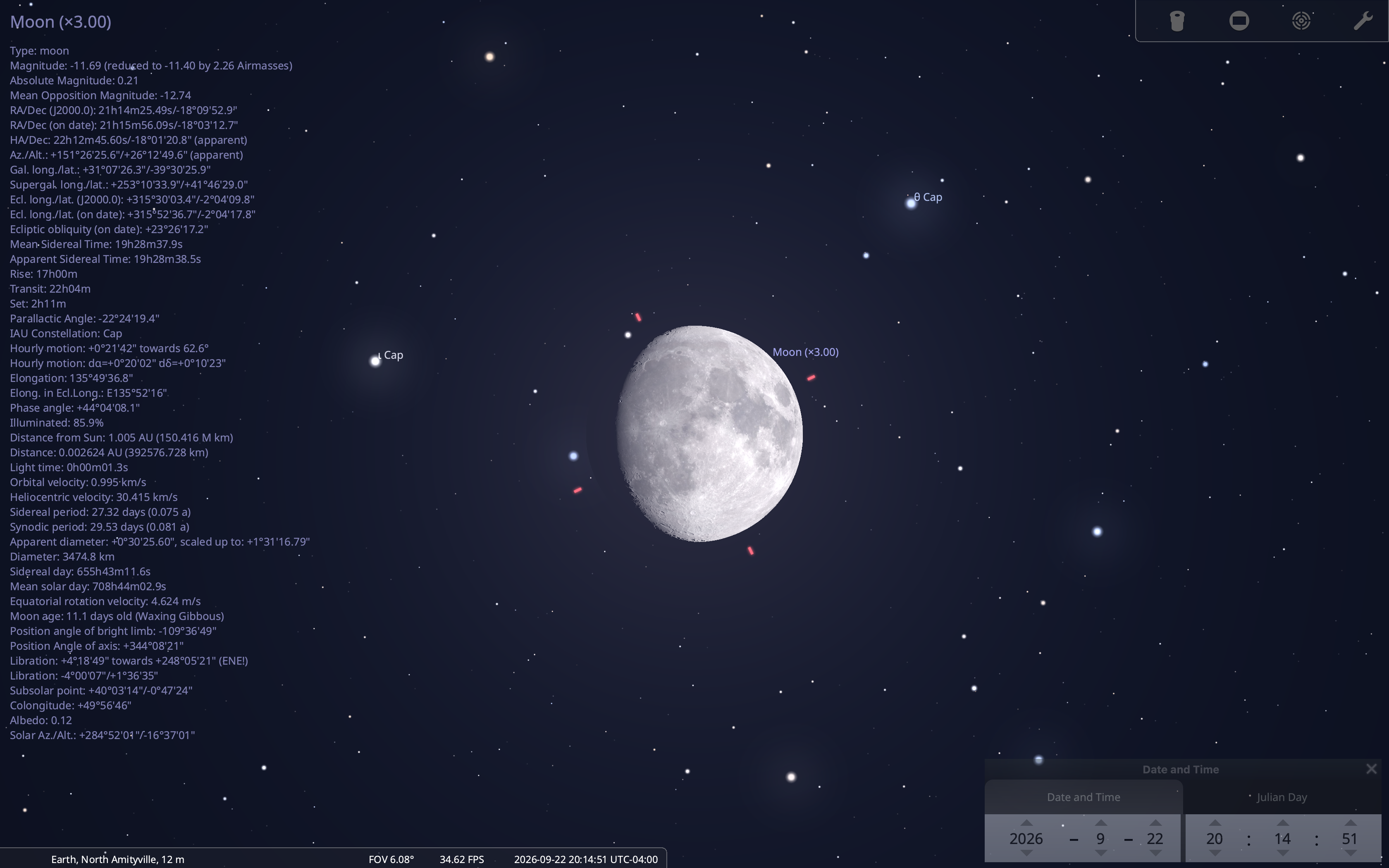
The waxing gibbous moon is in Capricorn on the night of this year’s Autumnal Equinox, September 22, 2026.