What would it look like?
What would our majestic Milky Way galaxy look like from a vantage point over 128 thousand light years above the galactic plane?
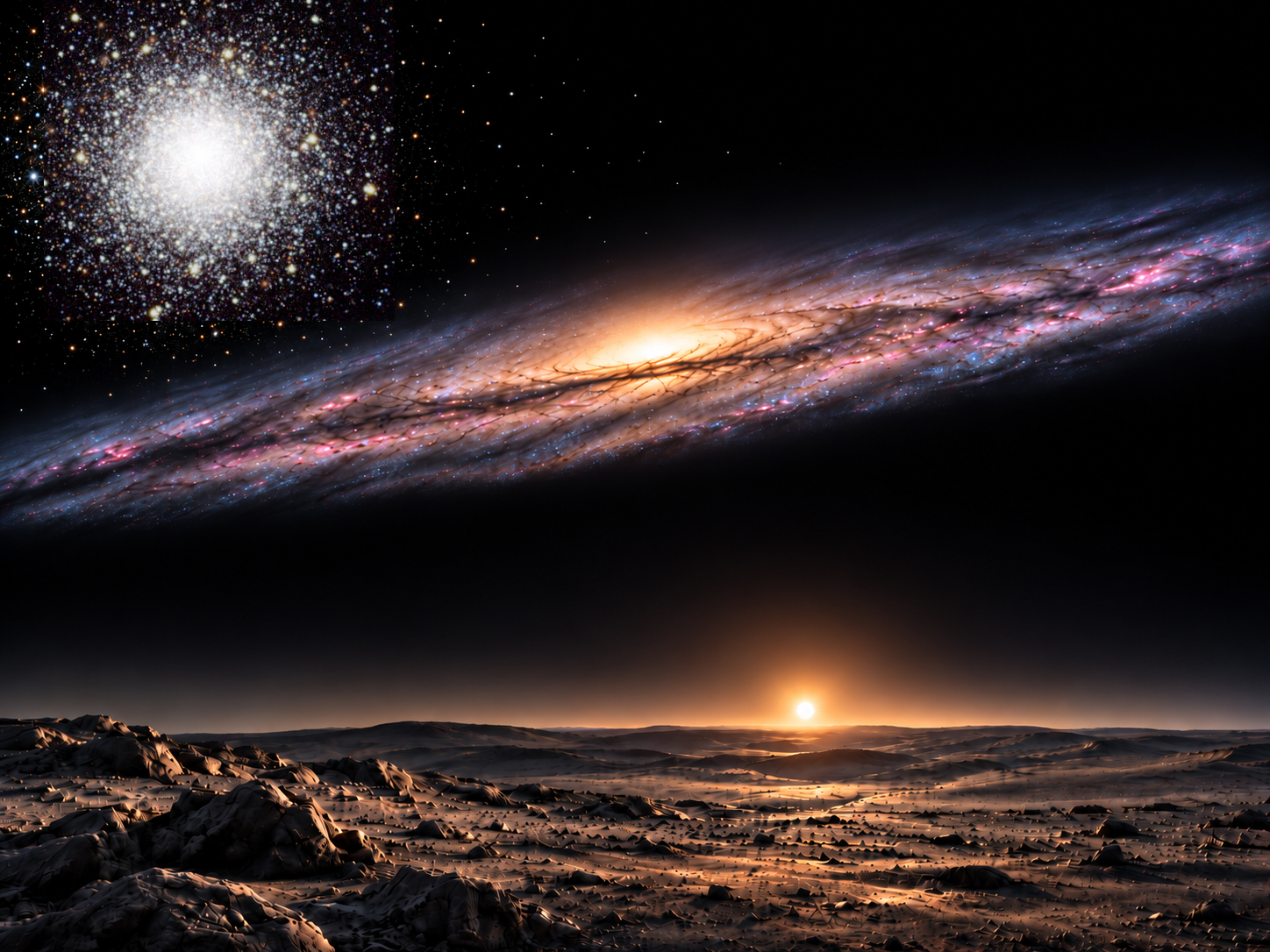
Click the image for full effect.
In this view towards the rising sun of a distant planet on the outer fringes of the “Intergalactic Wanderer” we see our Milky Way Galaxy seemingly suspended in Intergalactic Space hovering, as it were, in the background. All the stars we’re so used to seeing at night are in the galaxy, hence we have a starless sky. With the exception of this sun, the globular cluster and our galaxy are the only things we ever see in the sky above this hypothetical planet.
From here, our solar system’s location in the Milky Way is over 270,000 light years distant with the Milky Way’s galactic center another 30,000 light years more distant at 300,000 light years!
Imagine the Vista!
As viewed from this outpost above and beyond our galaxy, our majestic Milky Way subtends an angle towards us of approximately 25 degrees. From this vantage point and outpost at the outer fringes of the cluster and over 128,000 light years above the Milky Way’s galactic plane, our home galaxy seems to be suspended in Intergalactic space in the sky above this distant world. The cluster is so named because of its immense distance outside the galaxy at almost 300,000 light years from the galactic center. This distance is almost 3x the diameter of the Milky Way away!
The cluster is literally in intergalactic space, a unique environment from which to study and test our astrophysical models of stellar evolution and the various populations of stars as they age and evolve in such a setting. The great galaxy in Andromeda, Messier-31, is 2.5 million light years distant; this vantage point then, is roughly ~5% the distance to Messier-31!
NGC-2419, the Intergalactic Wanderer
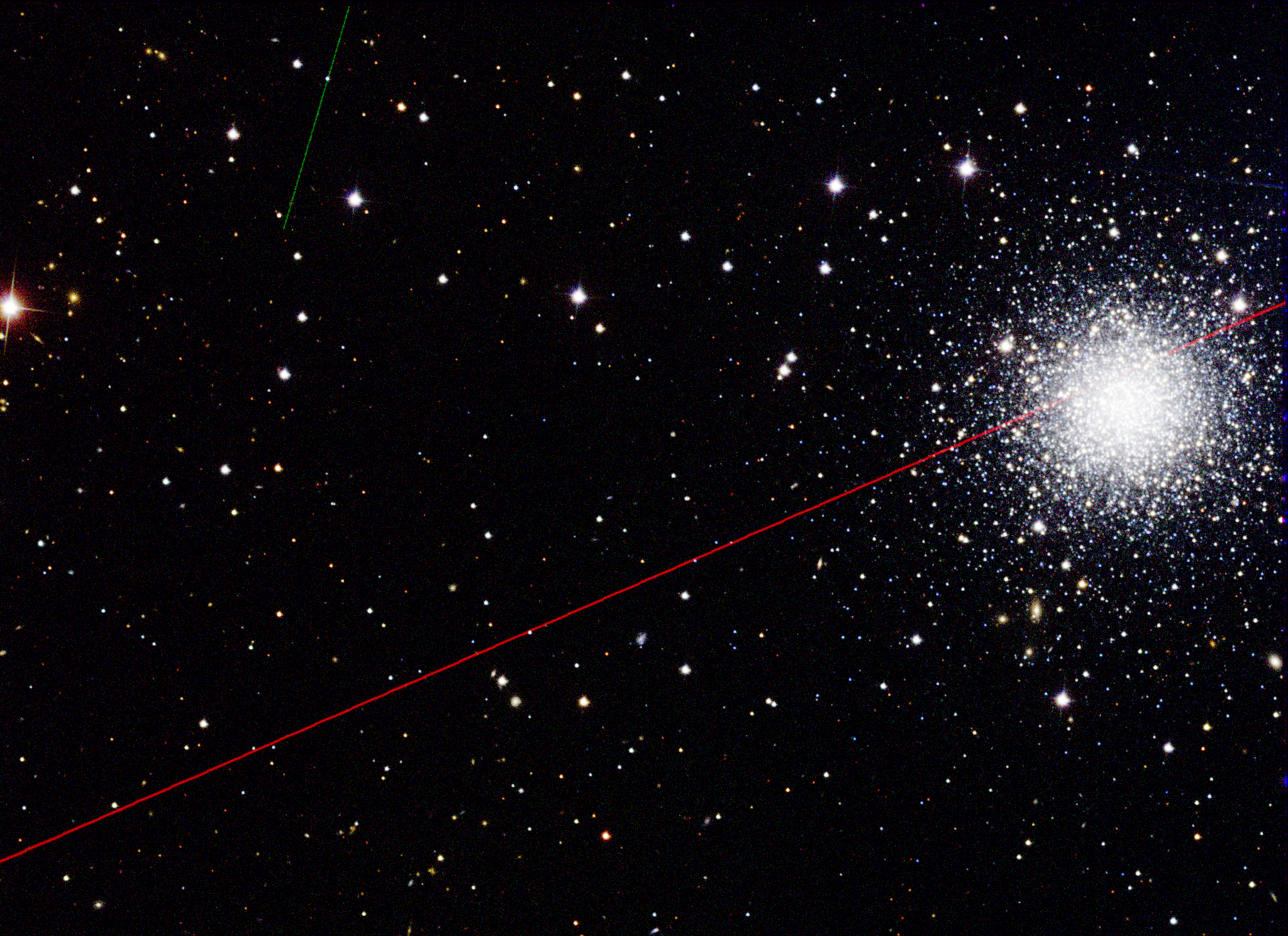
The Intergalactic Wanderer, Globular Cluster NGC-2419 in the constellation Lynx. Image credit: image data acquisition by the Sloan Digital Sky Survey’s 2.5 meter astrograph, image processing: the author using PixInsight 1.8.9-1. Red streak is a satellite or high-altitude aircraft.
Galactic Coordinates
To calculate the distance to the cluster, we need the cluster’s Galactic Coordinates or its position relative to our galaxy. Every object, every star, has multiple sets of coordinates such as Right Ascension and Declination (its position on our sky) but rarely do we ever refer to an object by its galactic coordinates. It is necessary in this case since the object of interest is outside of our galaxy, in intergalactic space!
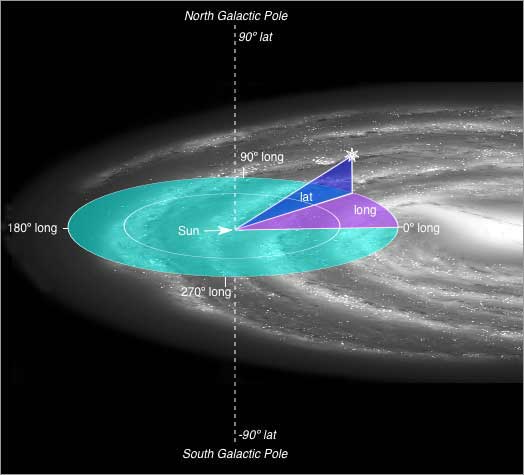
How an object is represented according to its Galactic Coordinates.
Galactic coordinates: 25.24 degrees above the galactic plane (its galactic latitude),
180.4 degrees relative to the Milky Way’s galactic center (its galactic longitude) and
line-of-sight distance from the sun and our solar system ~ 275,000 ly and 300,000 ly from the galactic center (in trigonometric terms, the hypotenuse of a giant right triangle – see illustration above). How we determined the distance, a determination consistent with the published distance, is described below.
Using the distance from the solar system, basic trigonometry provides a height above the Milky Way’s galactic plane of 128,681 Ly (the opposite side of the giant right triangle).
This isn’t the first time we’ve published an article about this Most Distant Globular Cluster nor will it be the last. This object is outside of our Milky Way’s confines and thus, presents us with a unique environment and laboratory to test our astrophysical models free of competing gravitational forces.
We can explore such questions as how do the various populations of stars evolve in such an environment, and what is this object’s history, ie. why is it located at such a great distance when the rest of the Milky Way’s galactic globular clusters lie within what is known as “The Stellar Halo” surrounding the galactic center. This region, where almost all of the roughly 180 galactic globular clusters are located, is part of a discovery that allowed astronomer Harlow Shapley to conclude that our Solar System is not at the center of the galaxy.
Age and Distance
There are many methods to determine distance, each increasingly less accurate. These methods are known as “Standard Candles”. The first, and most accurate, uses “Parallax” or how an object’s apparent position changes with distance and observation point. To demonstrate this, look across the room while alternately blinking your left and right eyes. Any object will appear to change its position relative to the background, an effect that diminishes with increasing distance. The angle between the apparent shift in position as you open one eye and close the other is the “Parallax” angle.
Astronomers use parallax to measure the distance to objects within our galaxy out to about 30 thousand light years. Most of the Milky Way’s population of galactic globular clusters are in this distance range, +/- 20%, some a bit more, some less.
The European Space Agency’s recently decommissioned Gaia satellite used the distance to the 2nd Lagrange Point, L2 (1.5 million kilometers from Earth, opposite the sun) as its baseline for the measurement of over 2 billion stars (~2% of the Milky Way’s population of stars) and thus was able to measure distances out to ~ 30,000 light years, the distance range where we find many of the Milky Way’s globular clusters. Excluding other elaborate parallax methods, this is the distance limit for parallax. Objects further than this use other, less accurate standard candles (such as methods that use known luminosity and absolute magnitude vs apparent magnitude).
So what of the distance to NGC-2419, the “Intergalactic Wanderer”? It is clearly beyond the “parallax limit”, so what other methods are available to determine its distance?
The Distance to the Intergalactic Wanderer
We’ll use the Tip of the Red-Giant branch (TRGB) method as the standard candle, the distance yardstick for NGC-2419. It uses the luminosity of the brightest red-giant-branch stars to gauge distance. So what are these terms: “Red Giant Branch”, Luminosity, Absolute and Apparent Magnitude?
Luminosity is the total radiated power over all wavebands.
Absolute Magnitude is a star’s apparent magnitude measured at 10 parsecs (32.6 light years).
Apparent Magnitude is the subjective brightness of a star without considering its distance or power.
The Red Giant Branch
The Red Giant Branch is the evolutionary track stars take as the evolve off the Hertzsprung-Russell’s Diagram of “Main Sequence” stars, the place where they’ve spent much of their productive life producing energy through the nuclear fusion of hydrogen into helium. Our sun is there now, on the Main Sequence, and will remain there for the next 3 billion years or so when it will cease hydrogen fusion reactions and forever leave the Main Sequence, move to the “Sub Giant” branch, eventually evolving to become a Helium burning Red Giant such as the beautiful ruby in our sky, Arcturus:
We are changing, growing, aging and Arcturus provides yet another deep lesson in this regard; it is an evolved, red-giant star, a star very much like what our sun will be with an age of 7.1 billion years. By contrast our sun has an age of 4.6 billion years, a star separated in time from Arcturus by only 2.5 billion years. It has the equivalent mass of the sun but 170 times its luminosity, a result of its expansion to 25 solar radii, a natural consequence of the transition to helium burning in its core, a process that is producing carbon and oxygen, the raw materials for new life and new worlds. If we want to know what will happen to our sun and to us, we need to look no further than Arcturus.
Astronomically speaking, Arcturus is close in time and in space, it is also close to us in a profoundly deeper sense; as we look it, we are looking at a reflection of ourselves, our destiny, our own sun in a mere 2.5 billion years. This should give us pause to reflect on our humanity and future together, one race on this tiny, pale blue dot.
Using Solar-mass TRGB Stars as Standard Candles
Using the Standard Solar Model as a basis, the TRGB magnitude for stars such as our sun is ~ -2.5 (negative 2.5). When describing magnitude, a more negative value indicates a greater brightness.
Why do we choose sun-like stars and why does this matter?
Low-mass stars, stars in the one-solar mass range have a well-understood and specific life expectancy. Higher mass stars, stars with expectant lifespans measured in the millions to hundreds-of-millions of years would have aged-out and died long ago and would no longer be visible. Because NGC-2419 is an ancient cluster, with an age of approximately 12.3 billion years, all of its high-mass stars would have died-out billions of years ago. The cluster’s remaining stars are relics, dating back to the first stars that formed, 1.5 billion years after the Big Bang.
That solar-mass range TRGB stars have lifespans measured in the 10s of billions of years makes them ideal standard candles. As previously mentioned regarding the one-solar mass star Arcturus, the brightest of these red giants are what our sun will have become in 3-4 billion years hence.
Look at the image of NGC-2419 above and take note of the brightest stars surrounding the cluster and their color. Those stars that appear golden orange or red are these red giant stars.
The Missing Piece of the Puzzle
We have almost everything we need to calculate the distance to NGC-2419. All we’re missing is the apparent visual magnitude of a TRGB star. How can we get that?
We’ve posted various articles highlighting our work and the development of a third-party add-on to the astroimaging processing platform PixInsight. In a recent upgrade to the HR D Plotter, we now have the ability to aggregate the Gaia data and produce a reliable distance determination based on the applicable data.
Since the HR D (Hertzsprung-Russell) Diagram plotter uses the current Gaia data release (an expanded data set to be released next month) to determine magnitude, parallax (distance), color and temperature, not all stars in a given image will be mapped or referenced – this is an inherent limitation of the HRD Plotter.
Limitations of Gaia
Since Gaia’s distance resolution is limited to ~30,000 ly, none of the cluster stars in NGC-2419 would have been mapped for parallax or distance. They were, however, mapped for visual magnitude, the necessary piece we need for our distance determination. We present that HR D Mapping below. The TRGB star used for our calculation has a visual magnitude of 17.4. There are other candidate stars, centered around a visual magnitude of 17.0. These sparse results are attributable to the extreme distance to the cluster and the limitations inherited by the Gaia data set. When the new Gaia data is release, we will revisit this object.
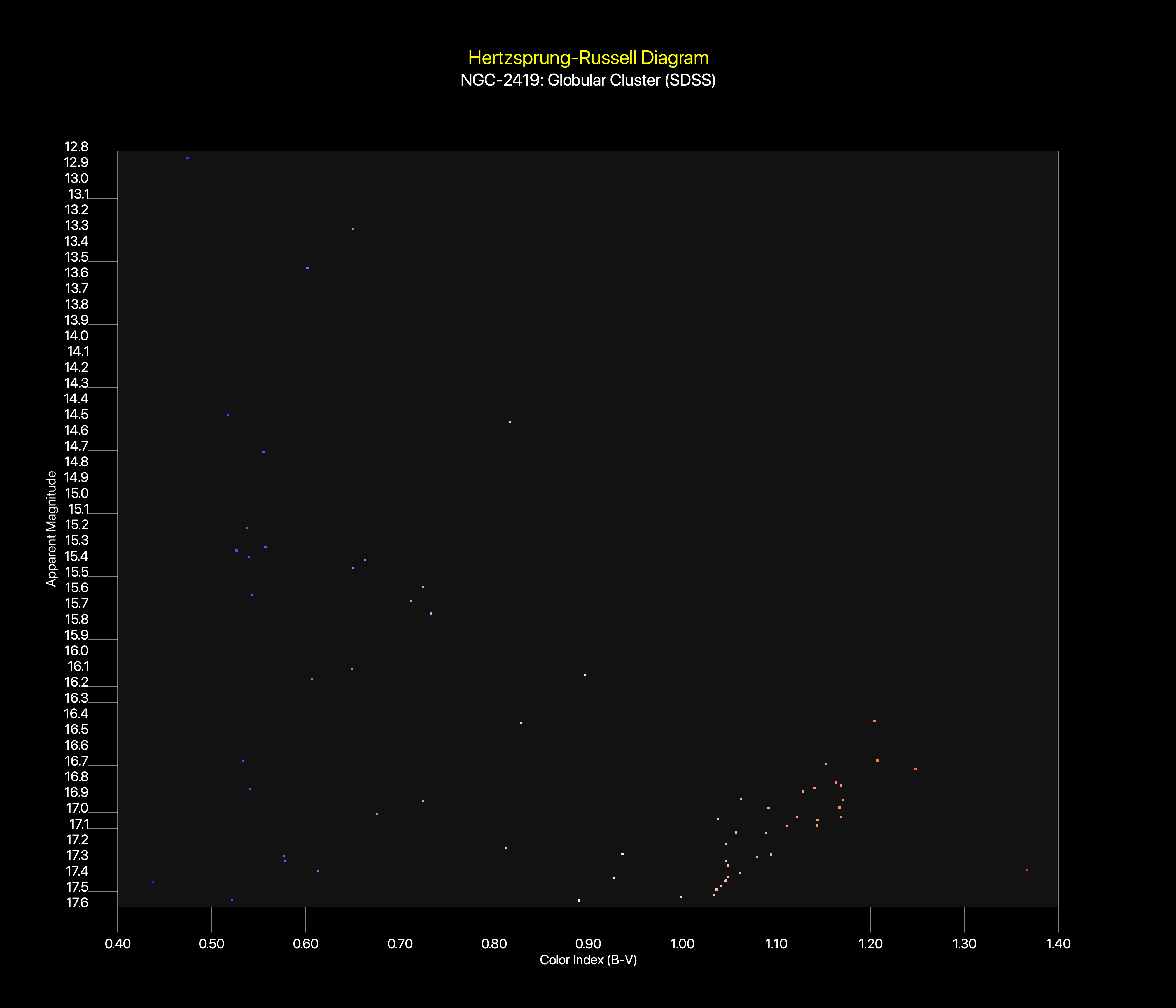
The TRGB stars mapped in this HR Diagram of NGC-2419 are seen at the foot of the diagram, “redder” than a color index of 1.00 and centered around a visual magnitude of 17.0. Image credit: the author. Data used in this plot was obtained with the 2.5 meter SDSS astrograph. For reference, please see the accompanying visual image above.
Related Article
If you enjoyed this article or it gave you pause to reflect, why not help us out with a modest donation, support our mission to affect positive change through astronomy and science education

Astronomy for Change is an AI Free Zone
From Las Cumbres Observatory, a quick, interactive web-based view of the sky at the moment, complete with interactive controls The Sky Now. The page includes “The Sky Tonight”, a quick, interactive web-based version of Stellarium.
Astronomy For Change: https://astronomyforchange.org
Did you enjoy this article or like what we do? Why not leave a tip or buy us a Coffee?
Follow Us On Twitter: https://twitter.com/astronomychange
Why not support us on Patreon: https://www.patreon.com/astronomyforchange
Imagination is more important than knowledge

An index of all articles can be found here.
Comment Moderation Policy
If you enjoyed this article, please consider supporting us with a modest donation
or through a subscription on our Patreon Page
Membership at Astronomy for Change is Free!