
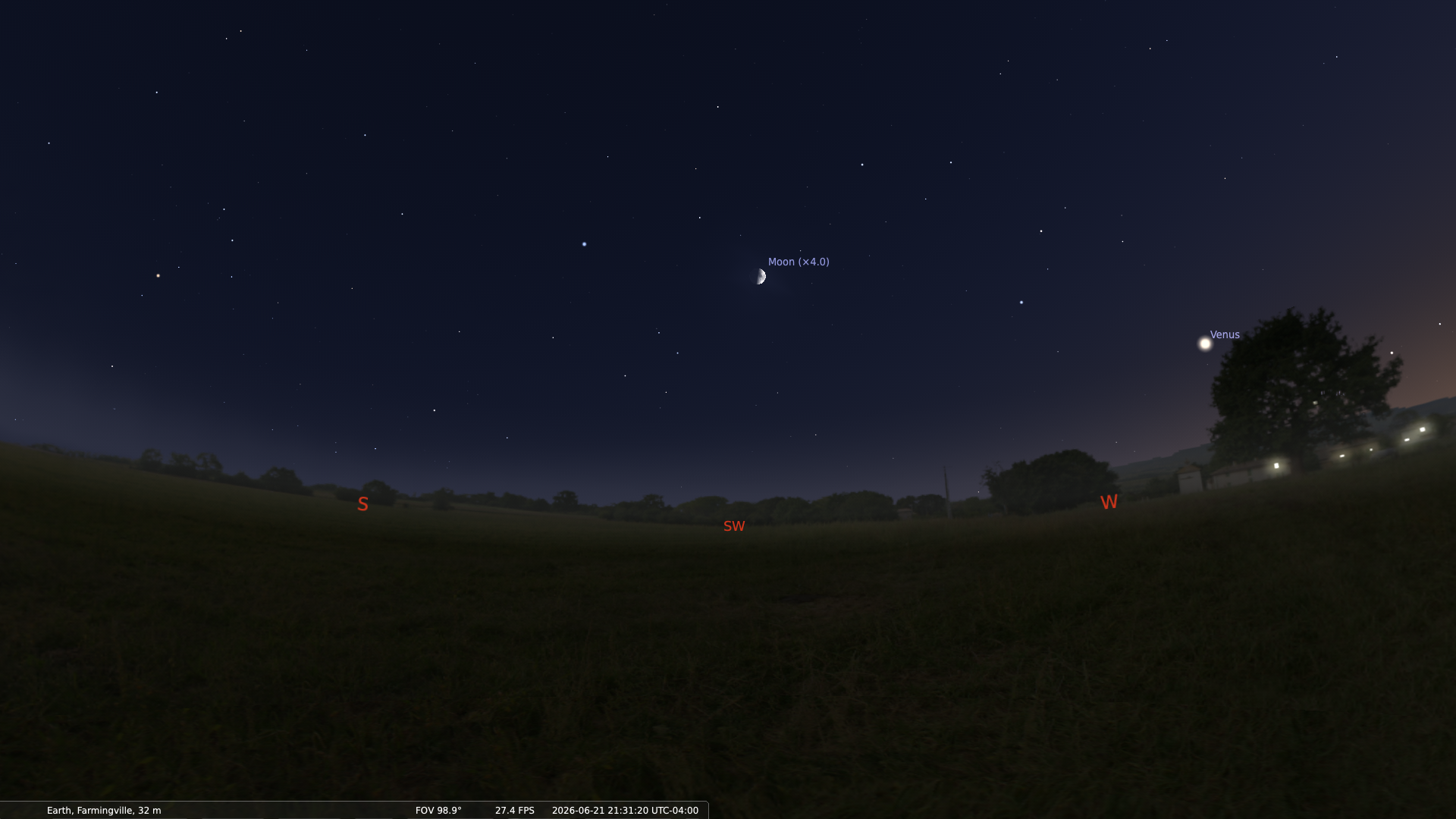
In this view to the south-southwest at twilight on the Summer Solstice, June 21, we see the lazy, first-quarter moon following the setting Venus along the ecliptic.
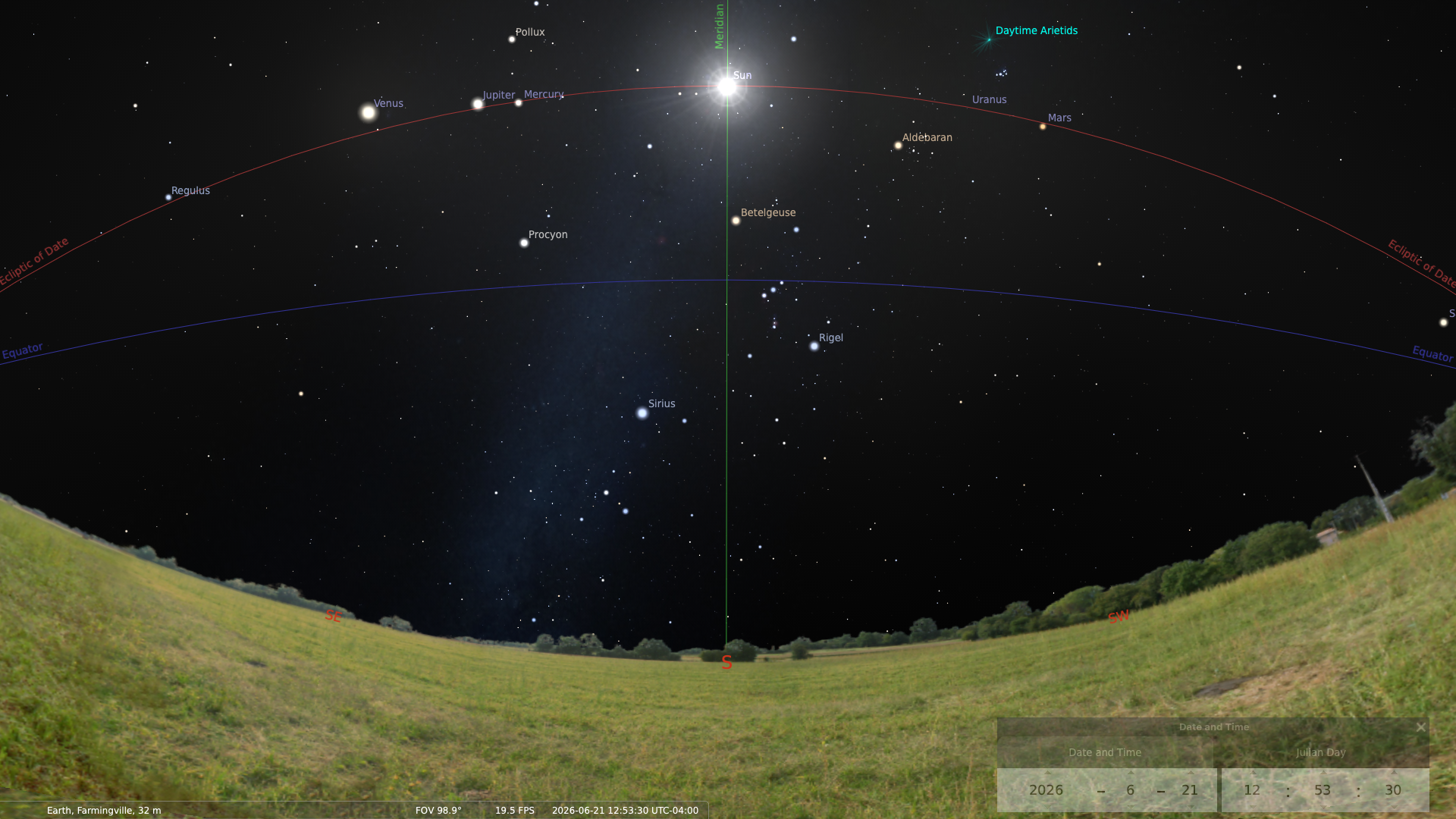
With the atmosphere removed, this view to the south at midday illustrates the sun, crossing the meridian 23.5 degrees above the celestial equator. To the east of the sun are Venus, Jupiter, and Mercury and, to its west, Uranus and Mars with Venus a brilliant Jewel following the sun as it sets.
The Summer Solstice, 2026
The 2026 Summer Solstice, the Astronomical beginning of summer and the longest day of the year in the Northern Hemisphere, occurs this year on Sunday, June 21, 2026 at 4:24 AM EDT. By contrast, our friends in the Southern Hemisphere experience the exact opposite; for them, it’s the shortest day of the year with the sun at its lowest point above the northern horizon. Take a look at the image above for the midday sky on the occasion of this year’s Summer Solstice. With the winter 6 months in the past, the sun is set against the winter constellations such as Orion and Canis Major.
For those who would like to see the sky at any given time, please open our “Sky Now” page.
What is the Summer Solstice?
Often referred to as the ‘First Day of Summer‘, a subjective term, the Summer Solstice in the Northern Hemisphere is the day the sun is at its highest point above the southern horizon at midday. In practical terms, this is the moment during the year when Northern Hemisphere inhabitants receive the greatest amount of energy from the sun. This angle above the horizon, known as the ‘Angle of Insolation‘, determines how much energy is received [from the sun] at a given latitude. In practical terms, this is the moment during the year when Northern Hemisphere inhabitants receive the greatest amount of energy from the sun.

Longest Day of the Year
The Summer Solstice marks the calendar as the longest day and, correspondingly, the shortest night in the Northern Hemisphere. Due to climactic factors and buffering by the earth’s atmosphere, we don’t feel the full effects of this maximum energy received for at least a month into July and August.
The seasons are reversed for our friends in the Southern Hemisphere. It is on this same day, they experience their Winter Solstice, or the point during the year when the sun is at its lowest point above the northern horizon.
This year’s summer solstice illustrated above with Stellarium shows the sun at the height of its travels above the southern horizon for 2025 on June 20th – 21st.
Without the atmosphere, we would see the background stars and constellations of winter such as Orion, the hunter and Canis Major, the great dog. We also note the separation of the plane of the ecliptic (the plane of the solar system) and the Celestial Equator, the projection of the Earth’s equator onto the sky. This separation is exactly equal to the earth’s axial tilt of 23.5 degrees.
Seasonal Changes in Climate
The seasonal fluctuations in climate are not caused by a change in the earth-sun distance. All orbits are elliptical and, with earth’s orbital eccentricity of 0.0167, it’s nearly circular. All planets have a perihelion or closest point to the sun and an aphelion, furthest point. The earth’s perihelion occurs during January, the coldest month in the Northern Hemisphere and aphelion during July, the warmest month.
The earth’s axis remains tilted at 23.5 degrees towards the same point on the sky in its orbit resulting in the sun’s changing elevation. This, in turn, causes the change in the Angle of Insolation and thus how much energy is received at the surface at a given location. The slight change in the earth-sun distance during the year has little or no effect on seasonal change in climate.
Seasonal Reflections and The Spectacular Jewels of the Summer Sky
As the last vestiges of the winter sky are low in the west at twilight, we look forward to the late spring and early summer sky.
With Lyra, the celestial harp, ascending the northeastern sky towards midnight along with Cygnus and the rich summer Milky Way following close behind, we’re certain that warm summer months will soon follow. Many would consider this their favorite time of year, a time that hearkens back to younger days, to a time when you could see magnitude 5.5 stars (the faintest stars visible to the eye are magnitude 6) and a breathtaking view of the Milky Way from many suburbs. With the fresh spring air, the smell of Lilacs and Honey Suckle wafting about with the temperature and humidity still moderate, it’s truly a pleasure to be out under the stars.
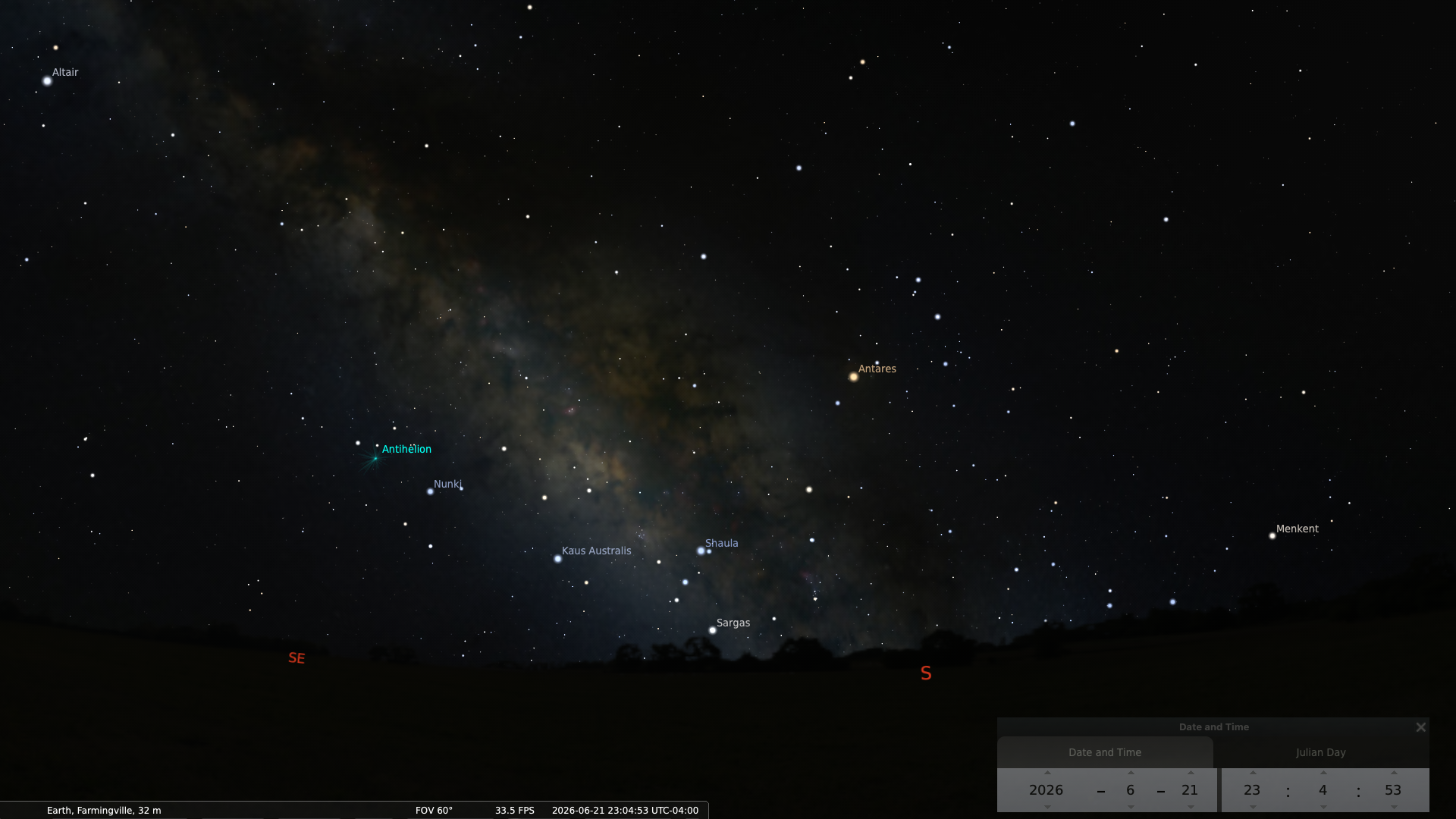
In this enhanced sky view to the south, the “TeaPot” of Sagittarius is seen to the east of Scorpio, the scorpion on the night of the Summer Solstice, 2026. The ethereal beauty of the Milky Way’s Galactic Center can be seen just east of the meridian.
As we look south on the evening of the Summer Solstice, we see the “TeaPot” of Sagittarius, the Archer, depicted in Greco-Roman Lore as a centaur, a half-man, half-horse mythological creature drawing a bow. To the west is Scorpio, the scorpion, both well-placed high in the southeast just before midnight.
We Explore Two Summer Favorites
We recently partnered with Insight Observatory, a world-class, remotely accessible observing network spread across 5 continents. As we mark this year’s Summer Solstice, we’re pleased to present two favorites of amateurs and professional astronomers alike, both for their observing and esthetic appeal and for the scientific value they hold.
Imaged by the author using Insight’s 0.40 meter (16″) Deep-Space Reflectors (Richey-Chrétien optical design), Messier-22 was imaged under the dark skies of Pie Town, New Mexico, USA and Messier-4 using Insight’s 0.40 meter (16″) Deep-Space Reflector located in Chile’s Rio Hurtado Valley. Both objects are Globular Clusters, vast agglomerations of stars with stellar populations between 100 and 300 thousand stars. Both are relatively close compared to other globular clusters with Messier-4 less than 7,000 light years and Messier-22 at about 10,000 light years distant.
Consisting of 110 objects, the Messier Catalog of non-Stellar objects was compiled by 19th Century French Astronomer Charles Messier whose objects of interest were primarily comets. He published this catalog more as an exclusion list of non-cometary objects: objects that were not to be confused with comets.
Both objects, well-placed now, during June and July, are visible with a good pair of binoculars. Messier-22 is located in Sagittarius and Messier-4 in Scorpio, just to the west of the meridian at midnight. Please see the view to the south above, Sagittarius appears as a “TeaPot” and the heart of Scorpio is marked by the brilliant Red Giant star Antares, the heart of the scorpion.
30-Second video showing the locations of both objects
| Messier-22 | Messier-4 |
|---|---|
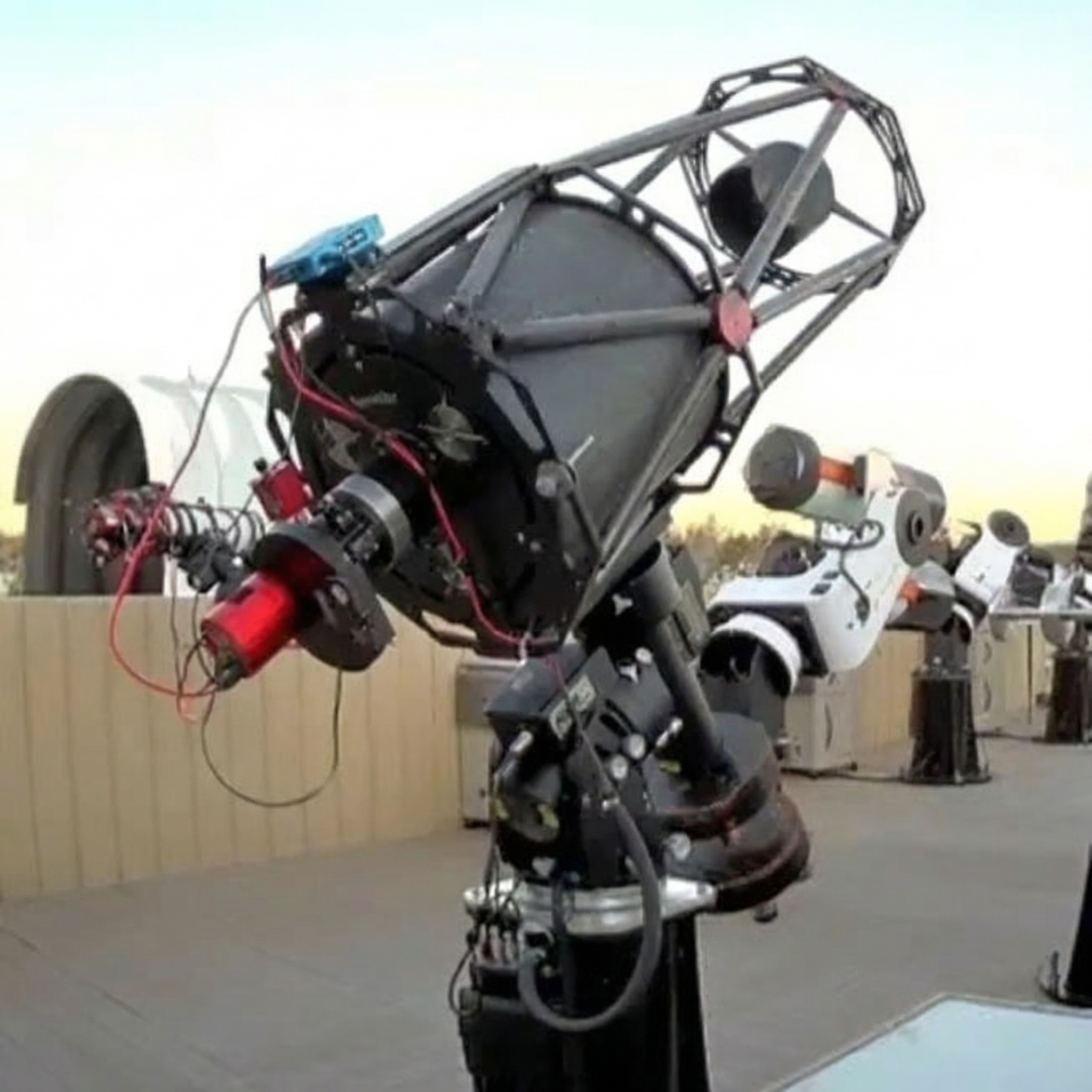 0.40 meter (16″) RC Deep Space Reflector of Insight Observatory’s Pie Town Remote Observatory. | 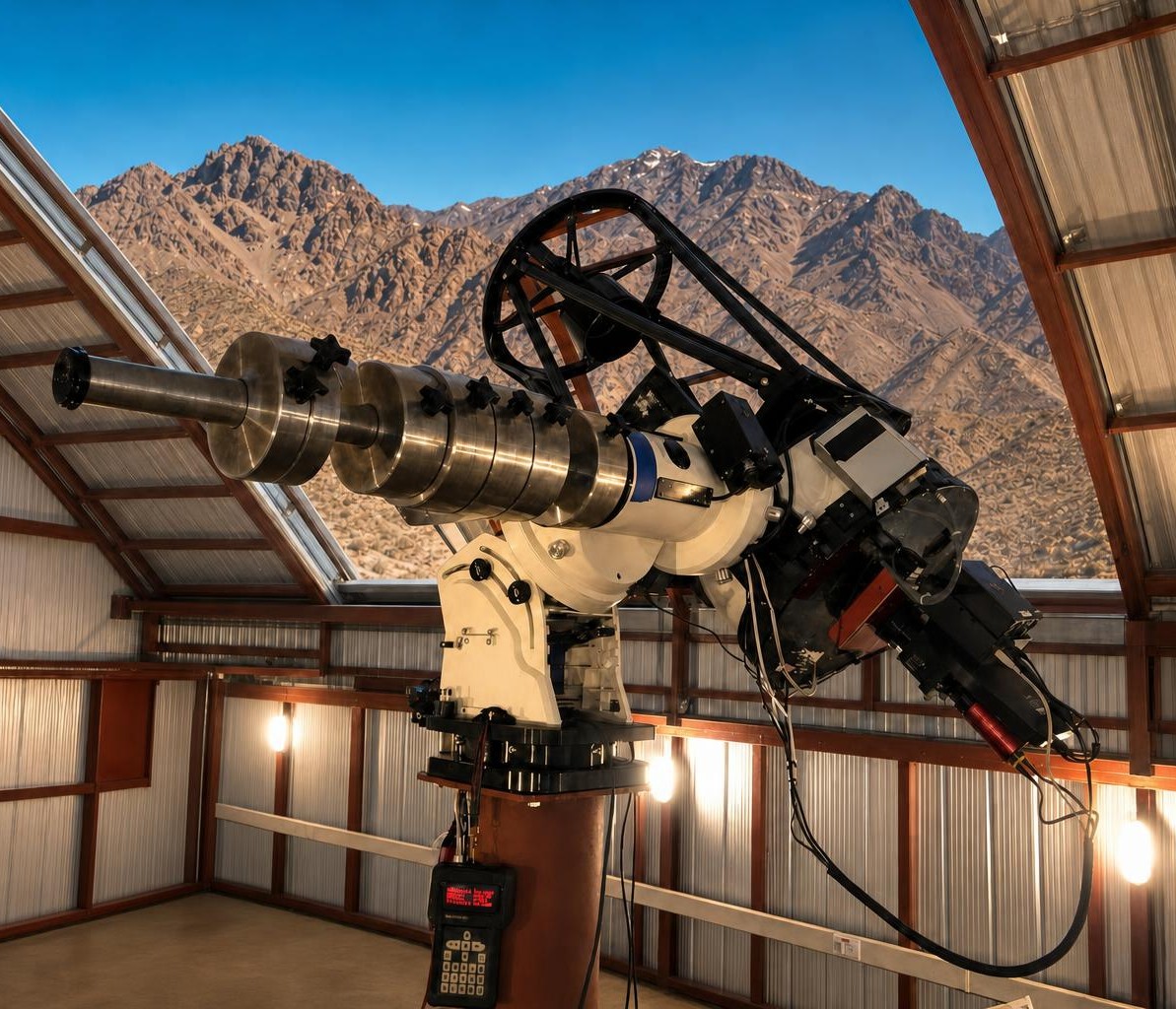 0.40 meter (16″) RC Deep Space Reflector of Insight Observatory’s Rio Hertado Valley, Chile. |
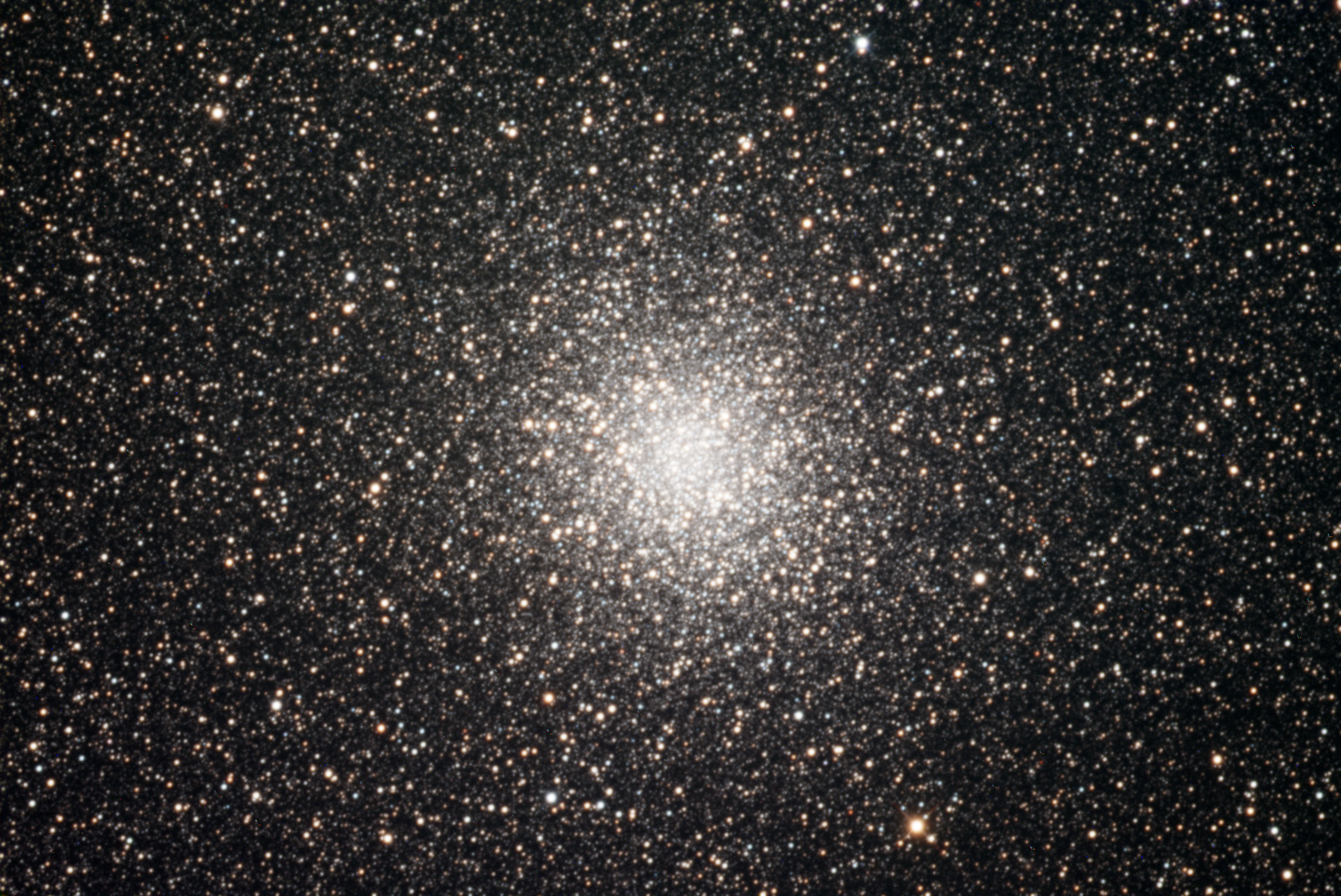 960 second (16 minute) exposure of Messier-22. | 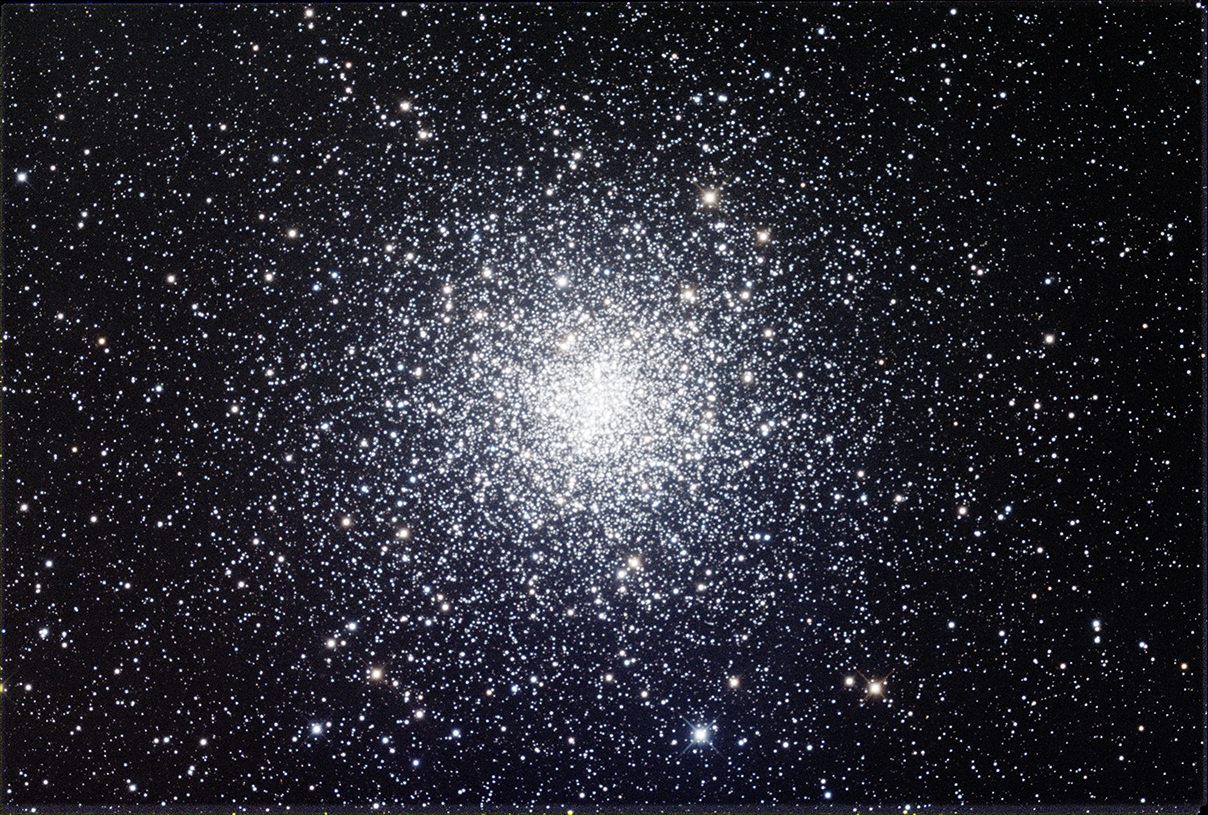 960 second (16 minute) exposure of Messier-4. This object appears larger than M-22 because it’s 3,000 light years closer at ~7,000 LY distant.
|
PixInsight and the HR Plotter
In addition to our partnership with Insight Observatory, we previously discussed a new feature available to users of PixInsight, a post imaging processing suite used by many astronomers and astrophotographers to process and enhance raw image data obtained with their telescopes and cameras. First published by Pleiades Astrophoto, a software development company based in Spain, it was originally created by Juan Conejero, a Spanish professional software developer, Astrophotographer, Engineer, Principal Developer, Co-Founder and CEO of Pleiades Astrophoto.
As recently as last year, a new tool was released as a third-party add-on to PixInsight that will produce scientifically valuable HR (Hertzsprung-Russell) diagrams. This tool imparts intrinsic value to images that would otherwise have only esthetic value. We release the full resolution images of Messier-4 and Messier-22 in a follow-up post along with the premier public showcasing of HR diagrams produced by PixInsight’s HR Plotter.
Note: With permission of the tool’s originator, the author modified the tool to run on older versions of PixInsight (1.8.9-1 Ripley, x64) and macOS Catalina (OS 10.15.8). Anyone interested in using this adapted version is free to contact the author.
Astronomy for Change is an AI Free Zone
From Las Cumbres Observatory, a quick, interactive web-based view of the sky at the moment, complete with interactive controls The Sky Now. The page includes “The Sky Tonight”, a quick, interactive web-based version of Stellarium.
Astronomy For Change: https://astronomyforchange.org
Did you enjoy this article or like what we do? Why not leave a tip or buy us a Coffee?
Follow Us On Twitter: https://twitter.com/astronomychange
Why not support us on Patreon: https://www.patreon.com/astronomyforchange
Imagination is more important than knowledge

An index of all articles can be found here.
Comment Moderation Policy
If you enjoyed this article, please consider supporting us with a modest donation
or through a subscription on our Patreon Page
Membership at Astronomy for Change is Free!


2 thoughts on “Summer Solstice, 2026 and Two Favorite Celestial Jewels of the Summer Sky”