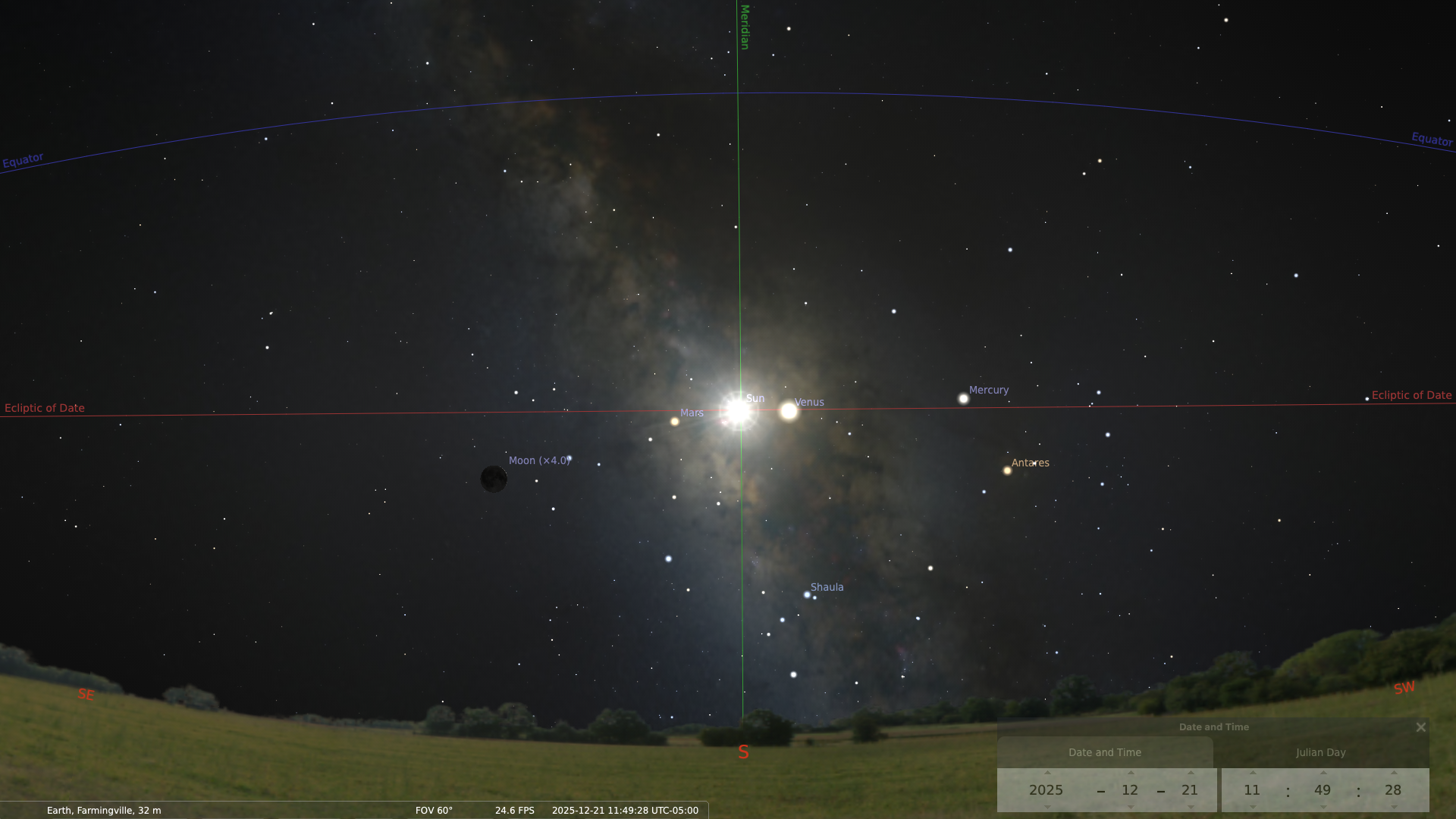
An animated view of the sky to the south today, Sunday, December 21, the Winter Solstice for 2025. The animation alternates between a view with the atmosphere and without and shows the elevation of the sun above the southern horizon, it’s placement along the ecliptic and angular separation from the Celestial equator. This separation today is equal to the earth’s angular tilt of 23.5 degrees from the vertical. A vanishingly-slim waxing crescent moon is east of the sun with Mars, Venus and Mercury flanking the sun to its east and west respectively along the ecliptic, all of which are lost in its glare at this time. The sun is set against the backdrop of the Milky Way’s galactic center. Click the image for download options. Image via Stellarium.
The Winter Solstice for 2025 occurs today, December 21 at 10:03 EST. The Winter Solstice is often referred to as the “official” beginning of Winter, a convention signifying that the sun’s passage across the sky will be at its lowest elevation above the southern horizon at midday in the Northern Hemisphere. Because the sun is at its lowest elevation for the year, we experience the shortest day and the longest night on this day.
For our friends in the Southern Hemisphere, the opposite of all the above is true. They experience the longest day and shortest night on this date during the 3rd week of December, a date that “officially” begins the Austral summer.
Animated View
In the animated view above representing this year’s winter solstice, the angular separation of the sun on the sky between the Celestial Equator (the projection of the Earth’s equator onto the sky) and the Ecliptic (the plane of the Solar System) is exactly equal to the angular tilt of the Earth’s axis of rotation. The animation represents what the sky would look like if we could “turn off” the earth’s atmosphere, thus providing a perfectly transparent view of the sky, free from atmospheric scattering, clouds and any weather.
The animation alternates between a view with the atmosphere and without. It shows the elevation of the sun above the southern horizon at midday, it’s placement along the ecliptic and angular separation from the Celestial equator. This separation today is equal to the earth’s angular tilt of 23.5 degrees from the vertical. A vanishingly-slim, waxing crescent moon is visible east of the sun with Mars, Venus and Mercury flanking the sun to its east and west respectively along the ecliptic, all of which are lost in its glare at this time. The sun is set against the backdrop of the Milky Way’s galactic center. The moon will follow the sun at its setting tonight and will be visible tomorrow, December 22nd as a thin, waxing crescent.
The sun is at its lowest point on the sky at midday during the third week in December in the Northern Hemisphere and represents the ‘beginning of winter’. The two Equinoxes (Vernal or ‘Spring’, 3rd week in March and Autumnal, 3rd week in September) occur when the sun crosses the Celestial Equator at the midpoint between these highest and lowest points of the sun’s apparent travel across the sky (the two solstices). The Celestial Equator represents the projection of the Earth’s equator on the sky. It should be noted that the Southern Hemisphere experiences the same seasons but at opposite times during the year. Summer in Australia occurs during December and January, while Winter occurs during June and July.
The Angle of Insolation and the Shortest Day and Longest Night
Often referred to as the ‘beginning of winter‘, a generally subjective term, the Winter Solstice in the Northern Hemisphere is the day the sun is at its lowest point above the southern horizon at midday. In practical terms, this is the moment during the year when Northern Hemisphere inhabitants receive the least amount of energy from the sun. This angle above the horizon, known as the ‘Angle of Insolation‘, determines how much energy is received from the sun at a given location. It derives from the earth’s axial tilt of 23.5 degrees from the vertical. With the axis tilted and always pointing towards the same point on the sky, the energy from the sun each hemisphere receives changes during the year.
Distance From the Sun
The earth’s distance from the sun does not play a major role in seasonal climatic change. The Earth is at perihelion (the closest point to the sun in its orbit) during January and at its aphelion during July. All orbits are elliptical, with the closest point and most distant point from the sun being the perihelion and aphelion, respectively. Aphelion actually occurs during July, while perihelion occurs during January. So, clearly, with the sun farthest during the warmest months in the Northern Hemisphere and at its closest point during the coldest months, the distance to the sun plays a minimal role in seasonal climatic change.
Astronomy for Change is an AI Free Zone

From Las Cumbres Observatory, a quick, interactive web-based view of the sky at the moment, complete with interactive controls The Sky Now. The page includes “The Sky Tonight”, a quick, interactive web-based version of Stellarium.
Astronomy For Change: https://astronomyforchange.org
Did you enjoy this article or like what we do? Why not leave a tip or buy us a Coffee?
Follow Us On Twitter: https://twitter.com/astronomychange
Why not support us on Patreon: https://www.patreon.com/astronomyforchange
Imagination is more important than knowledge

An index of all articles can be found here.
Comment Moderation Policy
If you enjoyed this article, please consider supporting us with a modest donation
or through a subscription on our Patreon Page
Membership at Astronomy for Change is Free!